


2025.04.22
Nakasendo Touring Day 5 (Second Half)
query_builder
2024/08/06
Nakasendo bike touring 2024
~Continued from the first half~
I promised to meet the German couple again in Tokyo and parted ways with them at Isseki Tochiba Chaya. I left the teahouse around 12 o'clock, and by that time it was full of foreign tourists from all over the world. I headed towards Tsumago.
The owner of Kojitsu Coffee in Tsumago-juku, where I visited yesterday, told me that there are two villages on the verge of being abandoned on the Samurai Road (the old Nakasendo road between Tsumago and Magome). He marked the locations of those two villages on the map. They are called Shimokitani and Shinmei.
I guessed that the number of households living in these villages had dropped to one or two. The locations are good, so it seems that they are exploring plans to revitalize these two villages (renovating old houses into guesthouses and renting cars, etc.). The owner is a member of the Tsumago City Council, so he is well versed in the local situation. It is also an important mission of this Samurai Road walk to inspect these two villages.
Walk along a pleasant path in the shade
After walking for a while, we reached a famous spot on the trail called Otaki and Metaki.
Although it is difficult to tell from a photograph, Otokotaki Falls is a waterfall that is both high and has a large amount of water, giving it a sense of violence. I imagine that people in the past would have cooled off by bathing in the water in this area.
There were also foreigners standing and sitting on a nearby bench.
Metaki is literally a quieter waterfall than Otokotaki.
The "downhill valley" is this area...
Beautiful cobblestone road
As we approached the Otsumago area, we came across a street lined with several long-established inns, reminiscent of the Edo period. Kongo-ya, the handmade soba noodle shop we had visited on the first day and been blown away by, is also in this area, so we immediately stopped by, but to our surprise, it was sold out.
I've been looking forward to it for the past few days, so I'm shocked (´;ω;`) uuuu
Handmade soba noodles " Kongoya "
I pull myself together and take a stroll around the Otsumago area.
This was probably my third visit to this area, and the foreign guests were relaxing there. The Otsumago area seems to be popular with inbound tourists.
Ryokan " Tsutamuraya "
Ryokan " Maruya "
The entrance to " Maruya ". It has a nice atmosphere!
(This is the family home of the owner of the traditional Japanese cafe "Koujitsu Coffee" in Tsumago.)
Ryokan " Hanaya "
Otsumago is a very atmospheric area that retains the atmosphere of the Edo period. It is not too far to walk to Tsumago-juku. There are few lodgings in Tsumago-juku, so if you were unable to stay in Tsumago, it might be a good idea to stay in Otsumago. It is not commercialized at all, but that makes it quiet and tasteful... (laughs)
Once you reach Otsumago, it's just a short distance to your goal, Tsumago-juku.
I wonder if this is the "Shinmei" the master was talking about...
When I arrived in Tsumago, I wanted to report to the owner of Kojitsu Coffee about the Samurai Road, but before that I took another stroll around Tsumago-juku.
Kamisagaya
Recreated stables

Oh, and I didn't stop by this time due to time constraints, but for those who are new to the area,
We recommend visiting Wakihonjin Okutani (Hayashi Family Residence) , Tsumagojuku Honjin , and Minami Kiso Town Museum and History Museum .
When I visited Tsumago 10 years ago, I was enthusiastically touring the Wakihonjin, so perhaps the guide thought I was an academically experienced person, and he showed me a room that was off-limits to the public (laughs).
First, he showed us the secret room for secret meetings . During the Edo period, it seems that a room for secret meetings was set up in each post town, possibly for policy purposes. In Tsumago, the secret meeting place was set up on the second floor of the wakihonjin Okutani, and in order to hide its location, the entrance door to the secret meeting room was designed to be indistinguishable from a closet door. Opening this closet-like entrance leads to a hidden staircase, beyond which is the secret meeting room. He actually let us enter the secret meeting room, which is off-limits (↓).
Wakihonjin Okutani: Secret Meeting Room
As it was a secret meeting room, it was specially soundproofed to prevent voices from leaking out. I wonder who was having secret meetings in this room, and when... The wallpaper was badly damaged, but since it was specially designed, the technology to repair it doesn't exist today.
If a secret rendezvous room was set up, it would have been either a honjin or a wakihonjin. I looked closely at other post towns this time, and found that while honjin ruins are often the remains, it is rare for either a honjin or wakihonjin building to remain as such. Are there any buildings in Japan other than Tsumago-juku that contain secret rendezvous rooms? If so, I think Wakihonjin Okutani (a nationally important cultural property) must be worthy of being a national treasure.
(If anyone has information about the secret meeting room, please let me know.)
Next, we were shown to the women's only room , which is also off-limits and located on the second floor. Unusually, the rooms here are 9 tatami mats in size. According to the guide, in the old days, there was a belief that when you reach 10, you go back to 0 (meaning 9 is the maximum), so they intentionally made the rooms 9 tatami mats instead of 10 tatami mats. Also, the sliding doors of this room have the following pattern painted on them.
To be honest, I don't know much about coats of arms, but when a certain scholar visited the temple, he was very surprised and asked, "What does it mean that there is a coat of arms that is the same as XX in Kyoto?"
According to our guide, Kyoto and Tsumago seem to have had connections.
I am still grateful to the guide who gave me a special tour of the off-limits room 10 years ago!!
After finishing our stroll around Tsumago, we stopped by Kojitsu Coffee to report on Samurai Road.
Unlike the situation immediately after the opening yesterday, the restaurant was almost full, with many foreigners in attendance.
In a town like Tsumago, where conservative elders hold real power, any attempt to promote the town would require time and hard work. Nevertheless, I was captivated once again by the charm of Tsumago-juku, which has boundless tourist potential.
According to the German person I met while traveling, Kyoto is a popular tourist spot well-known overseas, and when people think of Japanese tourist destinations, they think of "Kyoto and the Nakasendo Road."
I hope that the area will develop while preserving its traditions.
I chatted with the owner for about 30 minutes over coffee before leaving Tsumago.
I needed to go back to Magome where I parked my motorcycle, but I didn't want to waste time waiting for the bus, so I decided to take a taxi to Magome. It cost about 4,000 yen, but I considered it a necessary expense (lol).
I picked up my scooter in Magome and hurried to Narai-juku, my lodging for the night.
It's dusk, but I definitely want to stop by Atera Valley on my way to Narai, because this will be my last chance to visit the valley.
We arrived at Atera Valley at 5pm. The sun was setting, so we might not be able to see the best view, but it makes all the difference. Unlike Kakizore Valley, I had heard from the owner of the sword that we could see the view from our bikes, so we went along the valley on our scooters.
As you speed along on your scooter, the beauty of the valley peeks out from between the trees.
At a place that caught my attention, I parked my scooter on the side of the road and headed down into the valley.
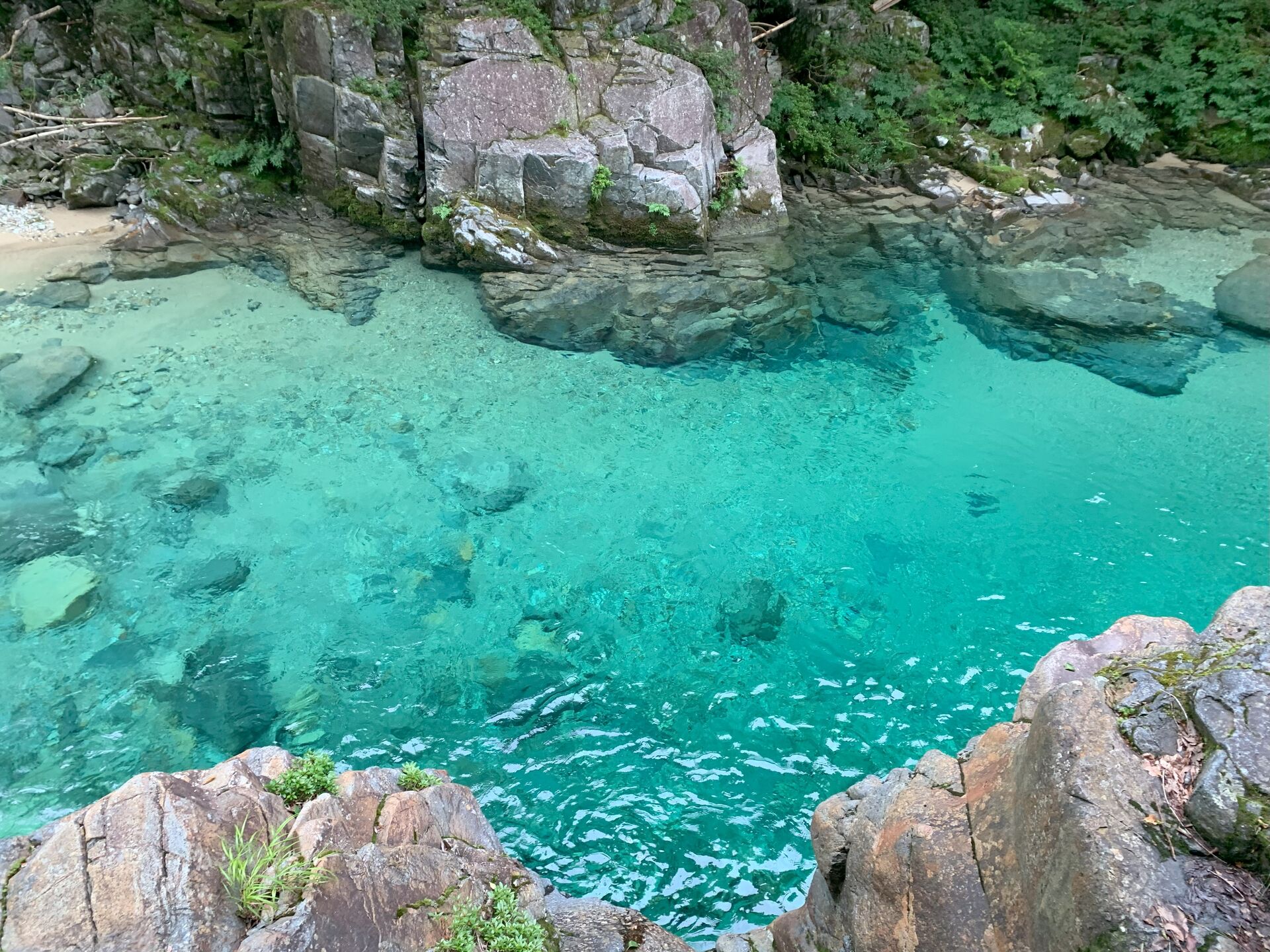
Wow, it's just beautiful.
Crystal clear transparency.
Kakizore Valley was emerald green, but Atera Valley was blue.
In fact, it is sometimes called "Atera Blue."
In Tokushima, there is the Niyodo River, known as "Niyodo Blue," but which one is more beautiful? (laughs)
It was a great decision to visit Atera Valley even in the evening!
If it's this beautiful on a cloudy evening, I wonder how beautiful it must be during the day on a sunny day...
Atera Valley and Kakizore Valley are definitely spots you'll want to visit when visiting the Nakasendo!
We hurriedly looked around Atera Valley and returned to the foot of the mountain at 5:30 pm.
Check-in at my accommodation tonight, Iseya in Narai-juku, is until 6pm and dinner starts at 6:30pm, so I let the inn know I will be late.
It takes about an hour from Atera Valley to Narai, so it's a tough journey.
By the time we arrived at Narai, it was already dark.
I parked my bike in the inn's private car park, but the owner said it was okay to park it on his porch, so I took Jog for a ride after dinner.
Narai "Iseya" is a long-established inn founded in 1818, and it is no exaggeration to say that it has the best location among the inns in Narai-juku.
It was an inn I'd always wanted to stay at, so I was extremely grateful to be able to stay there alone!
After checking in, the hostess showed me around the bathroom, dining area, and layout of the inn, then I was shown to my room. It was a 9-tatami Japanese-style room on the second floor of the main house, facing the main street, and the view of the street from the window was very elegant. For me, it was a very nice room.
It was past mealtime, so we changed into yukatas and headed to the dining area on the first floor.
I ordered some Japanese sake to go with my meal. Phew, so relaxing.
Looking around the venue, I saw two white women next to me. Judging from their accents, they were probably an American mother and daughter. The rest of the people seemed to be Japanese. The menu was beautiful and the food was delicious.
Perhaps because we started eating late, I ended up being the only one left in the dining area, and the landlady gave me information about the accommodation situation for inbound tourists, tourist routes, etc.
I had heard from the owner of Katana in Shiojiri-juku and the owner of Kojitsu Coffee in Tsumago-juku that the route foreign tourists take when traveling along the Nakasendo is "Samurai Road (Magome to Tsumago)" → "Yokawa Road (Tsumago to Nojiri-juku)" → "Take the JR train from Nojiri to Kiso Fukushima and stay overnight," but I was able to hear about their journey after Kiso Fukushima from the proprietress of Iseya.
After sightseeing and staying overnight in Kiso Fukushima, the next day they will travel by JR from Kiso Fukushima to Yabuhara Station, then walk further along the old Nakasendo road, cross Torii Pass, and travel to Narai-juku on foot, where they will sightsee and stay overnight. The next day, they will walk from Narai to the neighboring Kiso Hirasawa-juku, which is famous for lacquerware, and visit a lacquerware workshop, and then from JR Kiso Hirasawa Station they will all go their own way. Some people will go to Matsumoto or Tokyo by JR, and some will go to Hida Takayama, Shirakawa-go, or Kanazawa.
Now I have a full picture of the tourist routes taken by foreigners along the Nakasendo! (laughs) Tono and the owner of Kojitsu Coffee didn't mention Torii Pass, but since the area is far away, they probably weren't aware of it.
However, the two companies that plan and sell the Nakasendo tours for inbound tourists are " Oku Japan (a company in Tsumago) " and " Walking Japan (a company in Oita) ," and both the owner of the old-style cafe and the proprietress of Iseya shared the same understanding. They probably contact the two companies directly regarding matters such as accepting tour guests.
Also, in Narai there is a company that renovates sake breweries and old houses and operates a Japanese modern guesthouse called BYAKU. I learned from the proprietress that this is a business run by Takenaka Corporation in collaboration with the Forestry Public Corporation, with subsidies from Mr. Shiojiri.
Like other post towns, Narai has a closed-off side to it, and there seems to have been a lot of friction among the residents when the major general contractor Takenaka Corporation entered Narai (see the following website for details).
Takenaka Corporation's Narai Byaku Project
I brought a notebook and a ballpoint pen to the dinner venue and was frantically taking notes of what the hostess said. I guess it's rare to see a guest like that.
We were also able to hear about seasonal fluctuations, such as when there are more or less tours. Thank you very much to the landlady for sharing your valuable story!
After dinner, we moved the JOG, which had been parked in the inn's private parking lot, to under the eaves of Iseya.
What do you think? Does it look good? (LOL)
Taking a walk around Naraijuku at night in a yukata feels great.
A foreign family came out of the restaurant "Matsunami" looking satisfied after finishing their meal. They seemed even more satisfied when they saw me walking around Naraijuku in my yukata robes (lol). Narai is a beautiful place, so please go home feeling satisfied.
Return to the inn and take a bath at Iseya. It's a blissful time...
There are two locations, and if they are available you can rent them out exclusively (no reservation required).
Although it is not a hot spring, the bath is very spacious and clean.
It's hard to tell from the photo, but the bath is spacious, big enough for a family of four, including two elementary school children. There are also two washing areas.
After relaxing in the bath, I went back to my room and had a drink by myself with the chuhai I had bought.
I remembered that there were a variety of books on the bookshelf in the dining area, so I borrowed a KURA magazine from the dining area and gathered more information while having a drink in my room.
I see, it's "KURA, an information magazine for adults who love Shinshu."
As a man who loves Shinshu, I have to subscribe to this magazine from our company... I'm serious about that (lol).
Today was another extremely fulfilling day. I went to sleep feeling grateful for the opportunity to meet the owners of Kojitsu Coffee, Katana, the proprietress of Iseya, and other key people from each post town.
Distance traveled on Day 5: 127km
----------------------------------------------------------------------
Glory Management Co., Ltd.
Address: Toyo Building 3F, 1-2-10 Nihonbashi, Chuo-ku, Tokyo
Phone number: 03-3246-0088
----------------------------------------------------------------------
Old folk house
Old folk house
Inbound
Inbound
NEW
-
-
2024.09.08Fukushima Gunma Onsen...Fukushima Gunma Onsen Tour Day 1 (2024.7.16) We...
-
2024.09.06Fukushima Gunma Hot S...Fukushima and Gunma Hot Spring Tour Preparation...
-
2024.08.07Nakasendo Touring Day 6Nakasendo Touring Day 6 (2024.6.21) I wake up t...
-
2024.08.06Nakasendo Touring Day...~Continued from the first half~ I promised to...
-
2024.08.05Nakasendo Touring Day...中山道ツーリング5日目(2024.6.20)朝7時前に目が...
-
2024.08.03Nakasendo Touring Day...Nakasendo Touring Day 4 We left Tsumago-juku on...
-
2024.08.01Nakasendo Touring Day...Nakasendo Touring Day 4 (2024.6.19) I wake up a...
VIEW MORE
